The Habit Loops Behind High-Performing OKRs
What if your OKR process could deliver all of this?
- Consistent progress toward strategic goals, because priorities stay visible every week
- Immediate insight into performance, so leaders can act early instead of reacting late
- Faster, higher-quality decisions, grounded in real-time data rather than assumptions
- Reliable, high-signal progress updates, without time lost chasing or consolidating status
- Stronger cross-team alignment, with work clearly connected to company priorities
The OKR framework itself is straightforward: set objectives, define measurable key results, and track progress—and with AI-powered suggestions, you can create stronger ones. But for many teams, it still feels like something isn't clicking.
The goals are there, the structure makes sense, and yet somehow it all drifts into the background.
The secret isn't a better framework. It's habit.
When teams come back to their OKRs regularly, they stay connected to what actually matters. Progress becomes easier to understand, problems get spotted earlier, and conversations start from a shared, current view of reality rather than stale assumptions.
And when OKRs are used consistently enough to influence decisions, they start driving real outcomes.
The teams that get the most value from OKRs all share this pattern: they return to them every week. The question is, how do you make that happen without having to chase people?
That's what this article explores: how to design a system that people naturally come back to, and how OKR Dash builds habit loops that make OKRs part of the everyday flow of work.
Why frequency matters more than anything else
The real value of OKRs comes from interaction, not documentation.
When people engage with their OKRs regularly, they make better decisions, spot problems earlier, and adjust course before things drift too far.
When they don't engage regularly, OKRs become a static reference point - something that exists on paper but doesn't actually guide anything.
You don't need complex processes to fix this. What you need is consistent usage. Some research suggests it takes around 30 repetitions to embed something as a habit.
The real challenge, of course, is getting people to come back every week without chasing them. That's where habit design comes in.
The psychology: how habits actually form
Habits aren't built on motivation - they're built on repetition. Most behaviour follows a simple loop:
Cue → Action → Reward
A trigger prompts someone to do something, they take an action, and they get some kind of feedback or outcome. Over time, if the reward is good, the loop becomes automatic.
If any part of this loop is missing, the habit won't form. Without a cue, people forget. If the action feels hard, they put it off. And if there's no reward, they stop seeing the point.
A good OKR system doesn't just store goals - it embeds this loop into the processes so that it happens naturally, over and over again.
Here are the main loops that drive consistent usage:
Reminder → Check-in → Visible progress
This is the foundational loop, and it starts with a simple Cue: a check-in reminder that lands at just the right time. If it's missed, subtle overdue indicators appear in the interface. They don't shout, but they're always there, creating a gentle awareness that something needs attention.
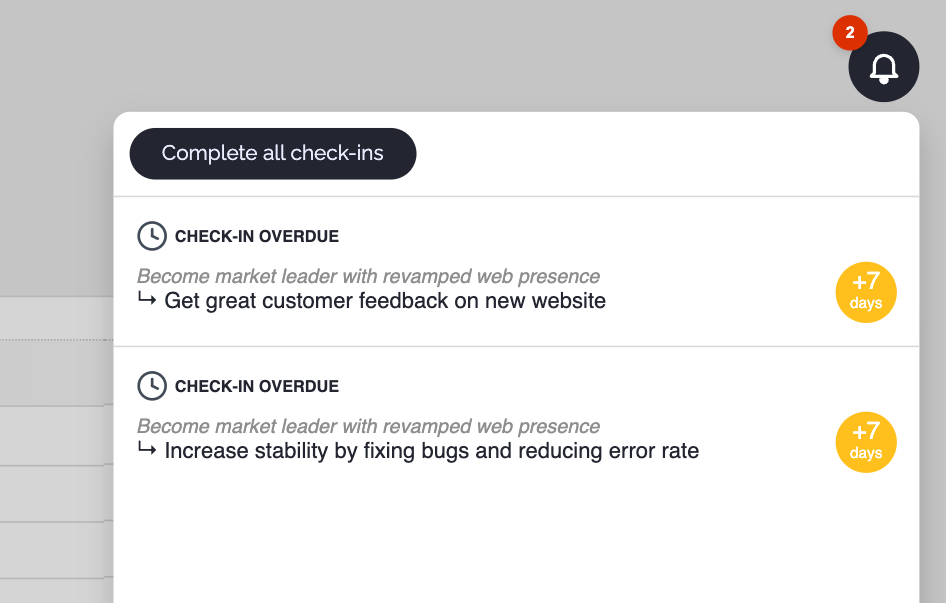
The key is that the Action needs to be fast. In OKR Dash you can jump straight into creating a check-in directly from the notification centre without navigating around, then write structured updates with WYSIWYG formatting and drop in images to show evidence, and move on.
If you've got a few updates to catch up on, the multi-step flow lets you work through them in sequence without breaking your stride. It doesn't feel like admin - it feels like a short, focused task.
Then comes the Reward. As soon as you submit, the update is visible everywhere: in the activity feed, on dashboards, and in presentation views. You know that anyone who needs to see it, can see it.
There's also a subtle psychological shift - you've done your part, you've communicated clearly, and stakeholders are well informed. That sense of closure matters more than people realise. A job well done.
Over time, this loop becomes automatic. The reminder comes in, you update, you move on.
Frequent check-ins create a continuous stream of signal, so leaders can support, steer, and make decisions based on what's happening now - not what was summarised weeks later.
Public discussion → Participate → Social reinforcement
Once updates exist, they don't just sit in isolation - they show up in the activity feed, alongside everyone else's work. This creates a different kind of Cue: you open the app and see activity happening. Progress, comments, reactions. The space feels alive, and that visibility naturally invites participation.
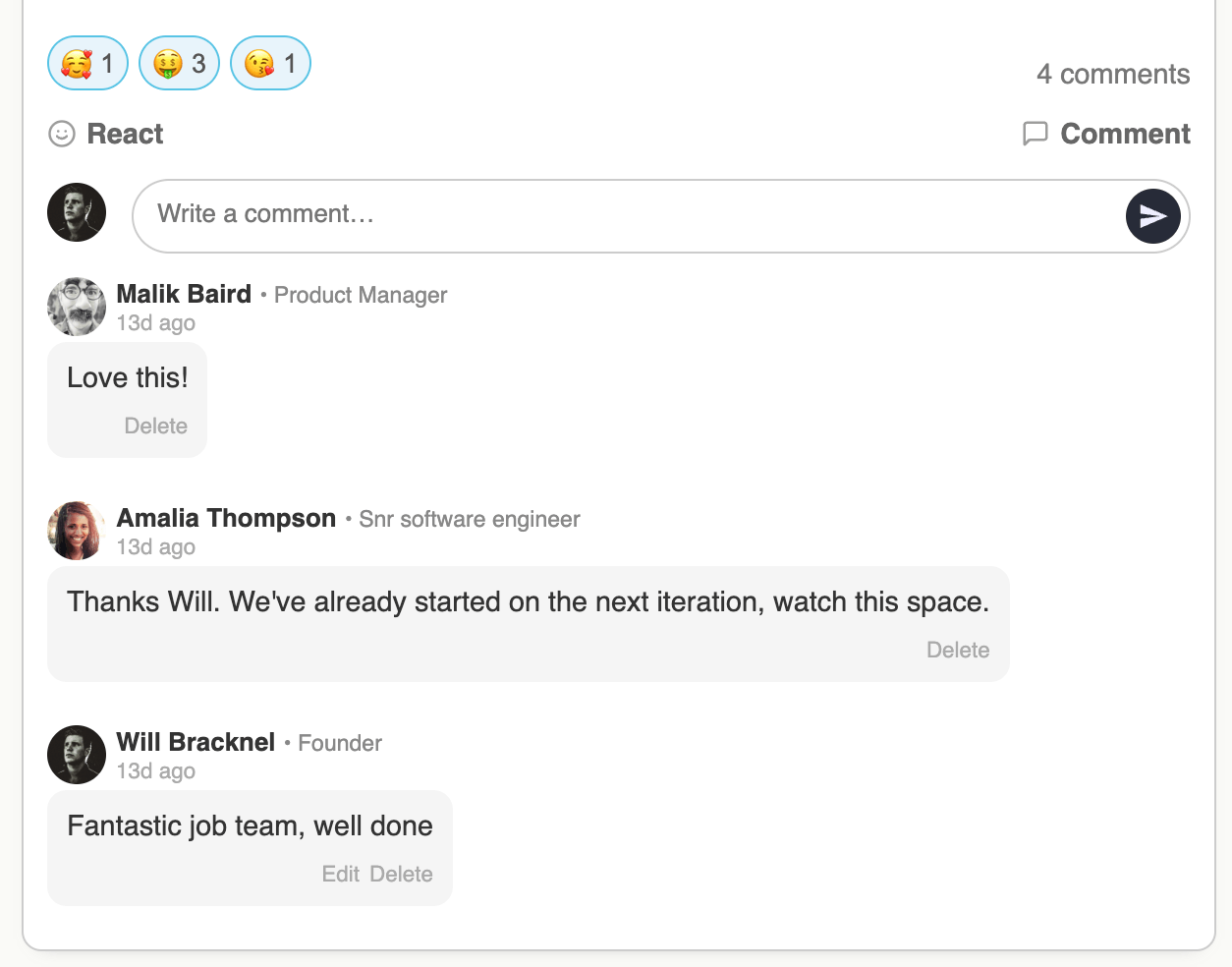
Action: someone reads an update and leaves a reaction. Another person asks a question. A teammate adds context. Each interaction is lightweight on its own, but collectively they build quickly into something meaningful.
The Reward here is social. You're not just updating into a void - you're contributing to a shared space where others are doing the same. That sense of momentum is something people naturally want to be part of, and it's where behaviour starts to spread. When one person engages, it increases the likelihood that others will too, and over time it normalises the whole practice.
A visible, active environment creates energy. Engagement increases across the board, and progress accelerates because more people are genuinely involved.
Comment notification → Respond → Ongoing conversation
This loop builds on the social layer. You post an update, someone comments on it, and you get a notification (in-app and a dedicated email so it won't be missed). That notification is a strong Cue because it's personal - someone is directly responding to your work.
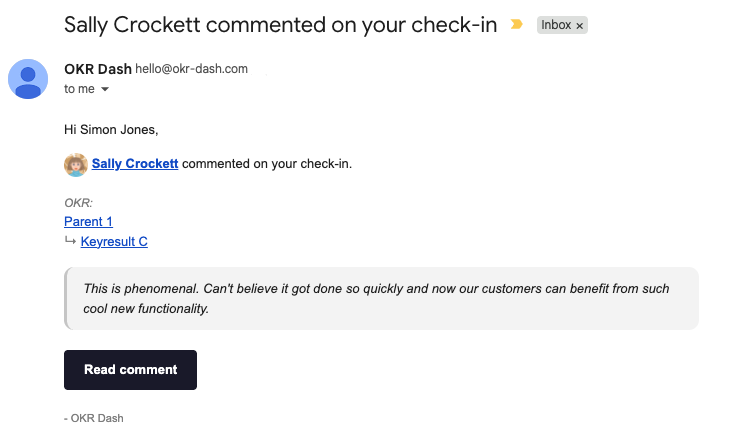
You take Action: click through, read the comment, and reply. Maybe you add more context, answer a question, or adjust something based on the feedback. The Reward is immediate: you're in a real conversation, engaging with stakeholders, and moving the work forward in a way that feels productive rather than bureaucratic.
What makes this especially powerful is that the conversation is visible. Others can see it, join it, and learn from it - it's not buried in a private thread or lost in the minutes of a meeting. One comment leads to another, and a short exchange often turns into a genuinely useful discussion.
Transparent discussions connected directly to the progress updates mean everyone is in the loop and decisions happen faster, and with better buy-in from the team and reduced meeting load.
New activity → Browse → Awareness
Not every interaction starts with a reminder or a notification. Sometimes it starts with simple curiosity - someone opens the app and notices that new activity is waiting for them.
This Cue shows in the sidebar and highlights how many new check-ins are waiting to be read, making it immediately obvious that something has changed. That small signal is often enough to pull people in, even if they didn't come with a specific task in mind.
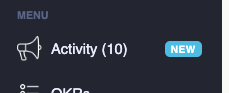
From there, the Action is lightweight: people browse through updates, scan for what's relevant, and click into anything that catches their eye. There's no pressure to act, just a natural tendency to stay in the loop.
The Reward builds quickly. Within a few minutes, you get a clear sense of what's happening across teams - what's progressing well, what might be slowing down, and where attention could be needed. It replaces guesswork with a current, shared picture of reality.
There's also something satisfying about seeing progress unfold in real time across multiple teams, and that feeling of momentum makes people more likely to come back and check again, gently building the habit for stakeholders and for team members who want to keep up with activity across the wider org.
This loop turns what might otherwise be dead time into useful awareness, without requiring any coordination.
Stakeholders stay informed without needing to ask for updates, which means they can step in to support teams earlier, make better decisions, and avoid surprises later in the quarter.
Dashboards → Engage → Clarity & familiarity
This loop is more deliberate and usually starts with a clear intent: someone wants to understand where things stand, whether that's in a meeting, during a review, or just as part of their regular workflow.
The Cue is receiving a link to a dashboard or a presentation view, depending on the level of detail needed. Dashboards provide a glanceable overview across multiple objectives, while presentation views are a focused review of recent activity on a single OKR in a clean, structured format.
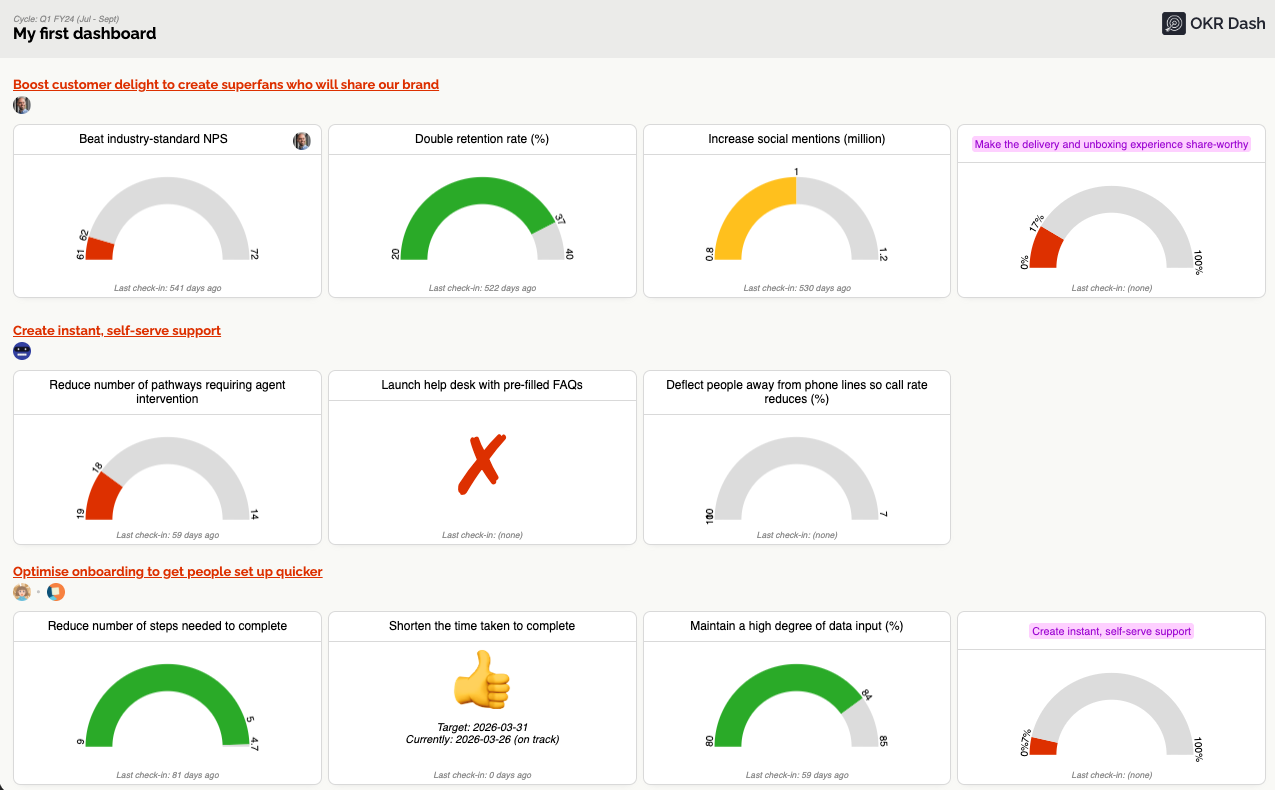
The Action is exploration - reviewing progress, drilling into areas that need attention, and often using what they find as the basis for discussion with their team, or passing on the latest info to other stakeholders or leadership.
Because the data is already structured and up to date, this process is fast. There's no need to gather information from different sources or reconcile conflicting updates, because everything is already in one place.
The Reward is clarity: you leave with a solid understanding of how your strategy is being executed, what needs attention, and what can be left alone. That reduces uncertainty and makes it easier to act with confidence.
Over time, this loop also builds familiarity. People learn where to look and how to find what they need to know. That familiarity makes it even easier to come back next time because the questions you had were easily answered.
Stakeholders who can self-serve the information they need without interrupting teams for updates means they can confidently give teams the space needed to stay focused on execution.
How the loops come together
Individually, each of these loops is useful. Together, they form a self-reinforcing system.
A typical weekly cycle looks something like this:
-
A reminder goes out and someone logs in to update their progress. They move through their key results using the check-in flow, adding context where it's needed.
-
Their update appears in the activity feed, where others have logged in specifically to check the latest news. The right people see it - some react, some comment. Discussion happens.
-
Notifications bring the original author back to respond to the feedback and adjust their plans, and while they're there, they browse other updates too and see how they can unblock another team with a little re-prioritisation.
-
Meanwhile, leaders review dashboards to get a high-level view, click into specific OKRs using presentation views, see the metrics not moving and read the latest check-ins to understand why.
-
Positive early intervention happens as a result, support is provided and decisions get made. Then more updates follow, and the whole cycle repeats the following week.
Over time, it stops feeling like a process and starts feeling like how work happens.
What changes when this works
When OKRs become a genuine habit, several things shift:
- They stay visible: people don't need to remember them because they see them regularly
- They influence decisions: when it's time to choose what to work on, the context is already there
- Leaders get real-time insight: they don't need to ask for updates because they can already see them
- Teams stay aligned: work is visible across the organisation, not scattered across many places
- Progress becomes continuous: you don't have to wait for a review meeting to understand what's going on
None of this requires extra effort once the system is in place. The behaviour sustains itself.
If you want better outcomes from OKRs, huge rulebooks and process documents won't cut it.
You need a system that makes the right behaviour easy, repeatable, and rewarding; one with clear cues, fast actions, and meaningful rewards.
When those elements are in place, people come back every week without being chased. That's what creates momentum, and over time, that momentum turns into results.
OKR Dash is specifically designed to embed these habit loops into day to day working, creating energy and momentum that will help you achieve your business goals. Try it out today, for free.
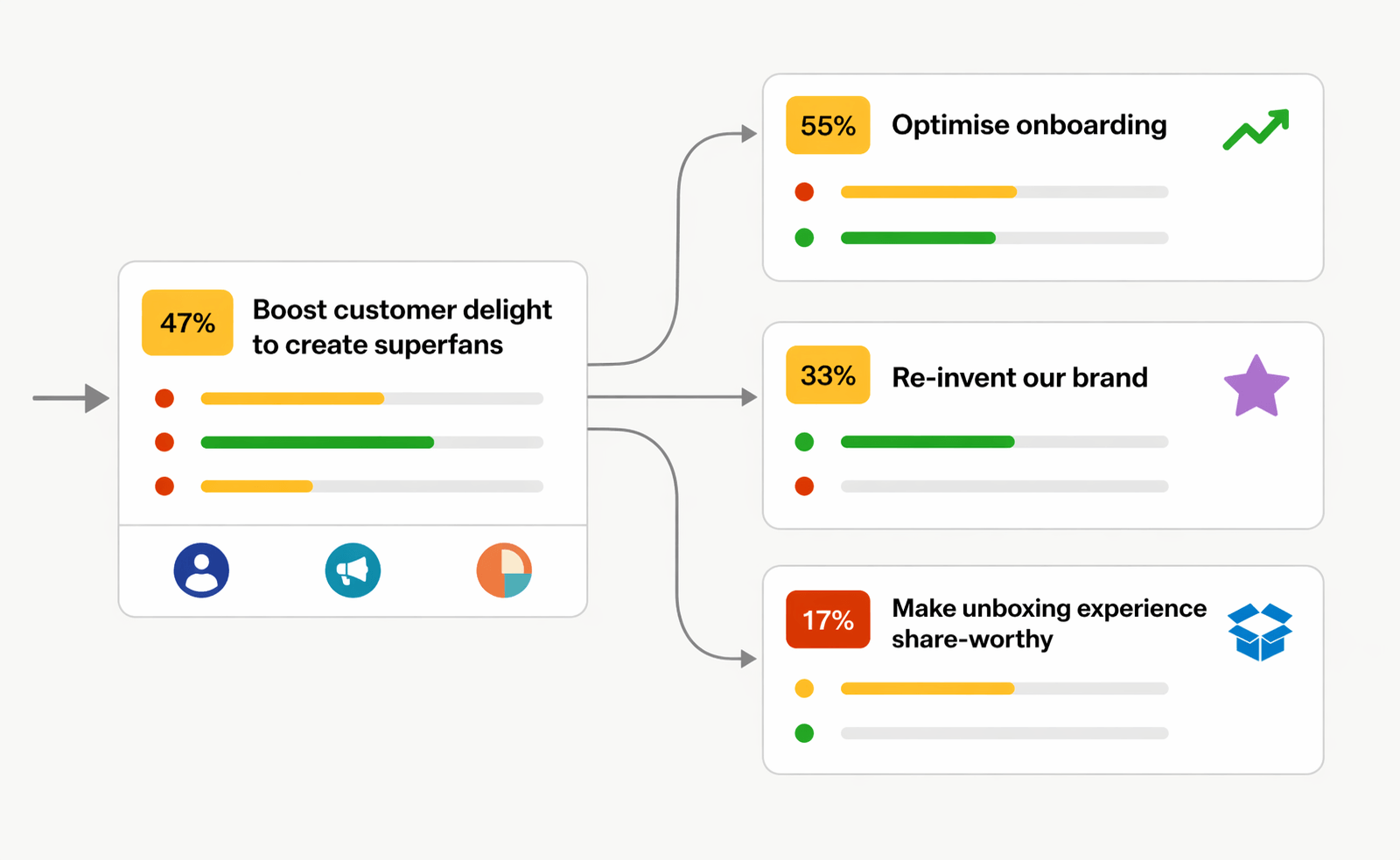
OKRs done right.
OKR Dash is a powerful tool for managing your OKRs.
No more siloed spreadsheets or manual tracking. One place to align teams and drive outcomes.