Our Story

"In my experience, the keys to making OKRs work are:
1. Transparency: everyone can see everything.
2. Alignment: all work is related, somehow. Visualise how it connects to see where effort is going.
3. Habit: OKRs must be at the forefront of every conversation.
Most tools do OK with transparency and alignment. But habit is where they fall down, and that's why I created OKR Dash to take a different approach."
Will Barden, Founder, OKR Dash
Will spent two decades working in tech companies, from early-stage startups with 5 people, through scale-ups, and enterprise organisations with 15k+ colleagues. Over that time, he watched OKRs get introduced with great fanfare, championed by leadership, workshopped at off-sites, and then quietly fail to get traction.
But he had also seen the flip side. He had been in teams where OKRs worked, where they created genuine clarity, where people understood not just what they were doing but why it mattered, where there was a real sense of shared purpose and momentum. Those experiences were hard to forget.
The problem with existing tools
The options for an OKR management tool split into several unsatisfying options:
- Spreadsheets, docs and slide decks that fall apart as teams grew, with no visibility, no history, and no way to see how things connected.
- Bolt-on modules added to project management or HR tools, which were often clunky and slow, and still didn't solve the core problem of building the habit.
- Enterprise platforms that were bloated, expensive, and so feature-heavy that teams spent more time wrestling with the software than actually thinking about their goals.
Every tool he tried seemed to assume the hard part of OKRs was writing it all down. It isn't. The hard part is building the habit: getting people to check in regularly, to stay honest about progress, to actually look at their goals on a Tuesday morning rather than just at end-of-quarter review.
Complicated interfaces gave people an excuse to avoid logging in. Dense dashboards buried the signal in noise. And most platforms were priced for enterprise procurement budgets, not for a team of 50 trying to get organised.
The first version
The first version of OKR Dash launched in 2019. Early users responded well to the structure it provided. Having OKRs all in one place, centralised progress updates visible to everyone, was a real step up from spreadsheets.
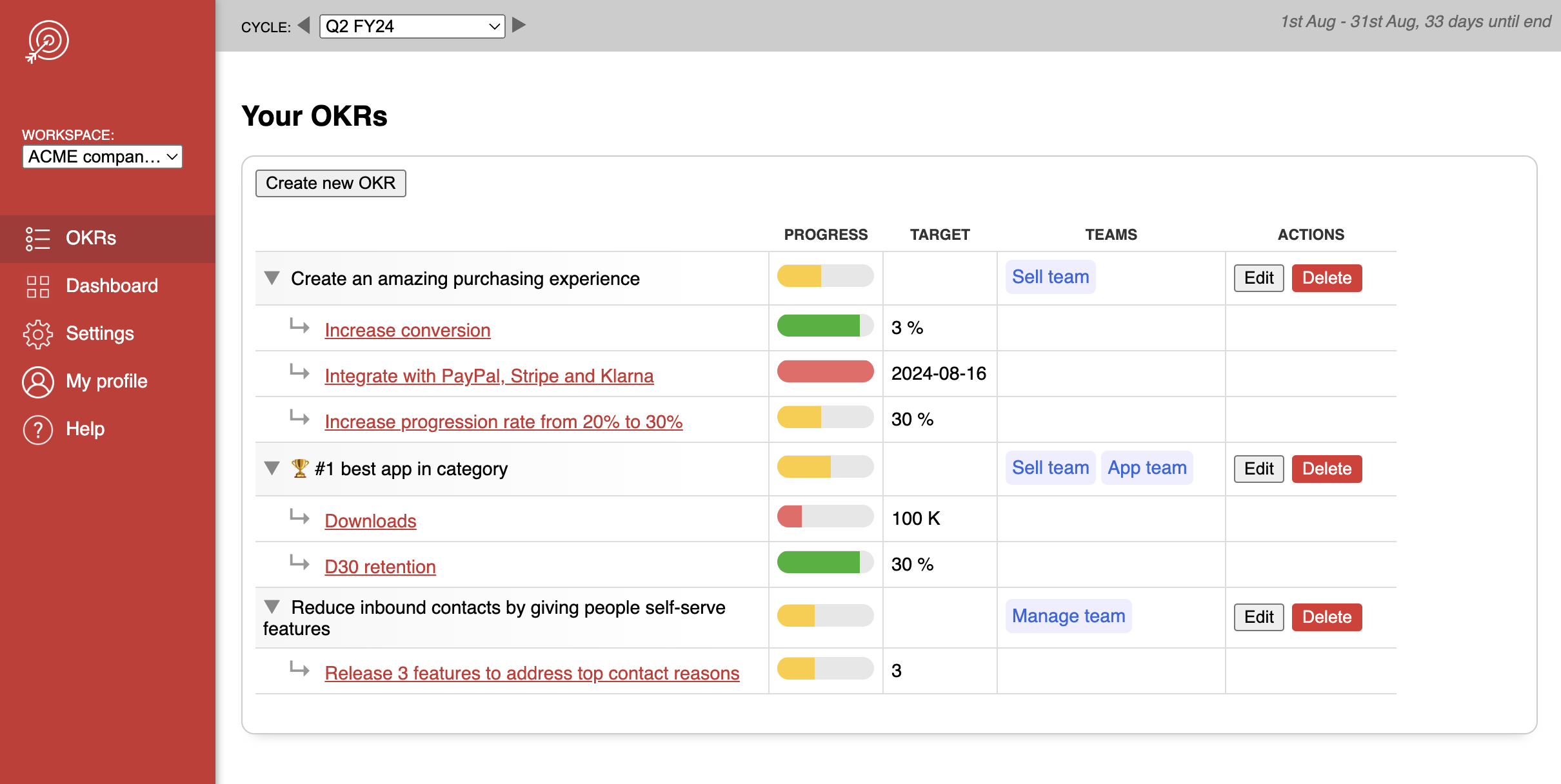
But something was missing. Most teams still weren't developing a consistent check-in habit. The tool made regular updates possible, but not compelling. People set their OKRs, nodded approvingly, and then mostly ignored them until the cycle ended. And alignment wasn't visual enough.
A complete rebuild
Over the following years, OKR Dash went through a complete revamp. The interface was rebuilt from the ground up, and the check-in experience was redesigned to be fast and frictionless. A suite of new features followed: AI-powered insights and suggestions, a real-time activity feed, alignment mapping, big-screen dashboards, snapshot reports, an import tool, and more.
Every addition was guided by the same question: does this improve transparency, alignment, and ultimately make it easier for teams to build the habit? Not just once, but cycle after cycle.
Built with care
OKR Dash is built and maintained by a small, focused team based in Perth, Western Australia. We believe in caring about details that most tools overlook.
Shipping regularly Keeping things simple Acting on customer feedback Transparent pricing Thoughtful design Software that 'just works'
We're building a tool for teams who take their goals seriously but don't want software that gets in the way of achieving them. If you've ever been in a team where OKRs clicked, where everyone was pulling in the same direction and you could feel it, that's what we're working to help more teams experience.
As seen on