How To Align Company OKRs to Team Work
The missing link between company strategy and team execution: how an Alignment Map fixes it
Recognise these problems?
- “We have company OKRs but teams keep working on what they were already doing.”
- “Our strategy deck and our roadmap don’t match.”
- “We announced priorities but nothing stopped.”
- "Every team says they support the company’s goals, but they all picked different things to work on.”
- “Everyone has OKRs that sound right… but we’re not achieving our high level aims”
- “We only notice misalignment when something ships late.”
Or ever heard teams saying this?
- “Why are we doing this?”
- “Is anyone else working on this with us?”
- “This feels like just busywork.”
- “We hit our OKRs but leadership aren't happy.”
Most organisations that use OKRs can articulate their strategy. They can also show you a long list of team and individual goals. What they usually cannot show you is how those two things connect.
That gap is where execution breaks down. Strategy lives in one place, while day to day work lives somewhere else. Teams do their best to interpret what leadership meant, but interpretation is not the same as alignment.
The purpose of alignment is simple. You should be able to look at any piece of work and see how it contributes to the company’s most important outcomes. When that is not visible, OKRs become a reporting exercise rather than a system for steering the business.
This is the problem the alignment map is designed to solve. It’s simply a tree view, which shows the relationships between OKRs across the company.
But that sounds like ‘cascading OKRs’, which is bad, right?
Major objections to cascaded OKRs fall into several categories:
-
Leadership are too far away from the customer and therefore shouldn’t be setting OKRs. This is unrealistic. Leadership’s role is to set strategy, and so they’ll always be involved in what teams are doing. But good leadership will partner with all levels of the company to continuously shape direction, while bad leadership will ‘ivory tower’ some OKRs and hope for the best.
-
Multiple layers of cascading OKRs gradually lose the original intent, the further away they get. A small number of layers is OK, a large number will be fuzzy. OKR best practice generally says only create a small number of OKRs to maximise focus. If you find yourself with a huge hierarchy of OKRs, then you’re doing OKRs wrong - it’s not the cascading that’s inherently bad.
-
Teams lose autonomy in decision making about their OKRs. Rigidly passing down OKRs to lower levels is bad practice. Teams should always be able to set their own OKRs, but it’s always done within the context of higher level company goals. They should always be looking ‘up’ to see where their department or the company is headed, and aligning their work appropriately - that’s good practice.
-
High overhead from approval meetings and delays waiting for the people ‘above’ to decide their OKRs. Again, this is a failure of the OKR setting process, not the idea of cascading OKRs or showing the relationship between efforts.
To us, these are all problems with the process that some companies are using to set OKRs, not problems with relating OKRs to each other or linking them together.
OKR Dash’s model is not a top-down command chain. It’s a flexible contribution model which enables a more empowered process. Jeff Gothelf has the same advice about alignment over cascading.
Even if you don’t cascade OKRs, the work across your org is still related to each other in some way. The alignment map surfaces those relationships for everyone’s visibility and it’s like unlocking a superpower.
What alignment really means
In a well aligned organisation, company objectives are not just statements of intent. They are connected to the goals of every team that contributes to them.
When a team creates an OKR in the product, they do not just give it a name and a target. They also link it to the objective it supports. That link is explicit and visual and creates a structural 'map', reducing ambiguity.
Let’s go through an imaginary but realistic scenario, starting with this top level company objective, and create a tree view alignment map:
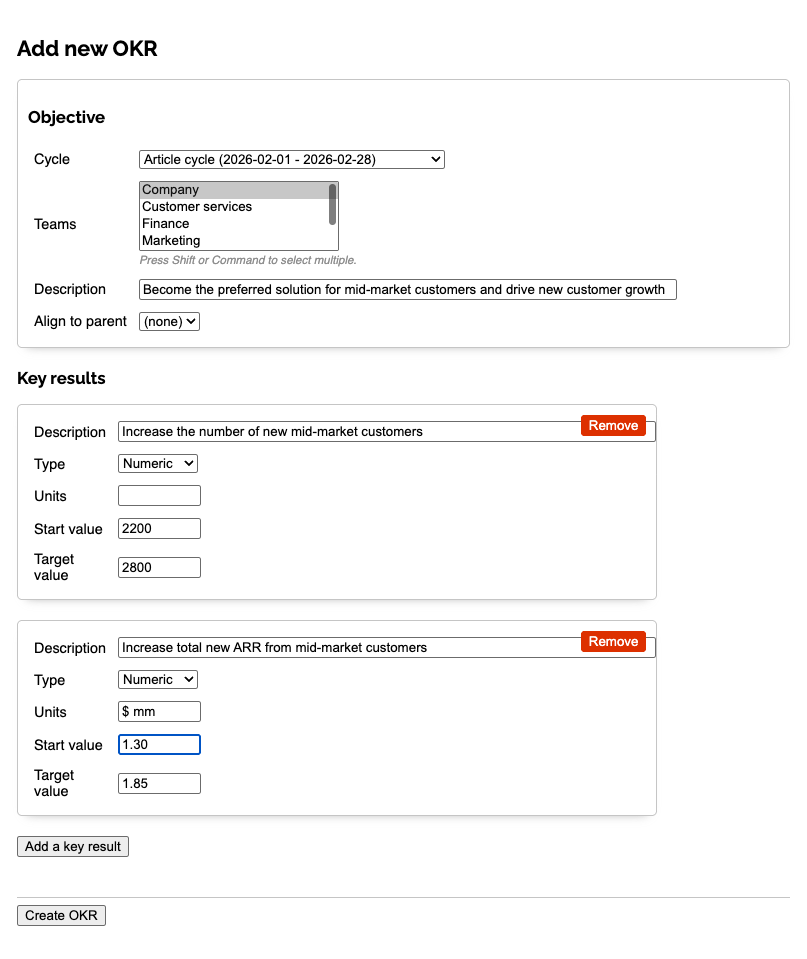
Company: Become the preferred solution for mid-market customers and drive new customer growth.
Increase the number of new mid-market customers from X to Y
Increase total new ARR from mid-market customers from $X to $Y
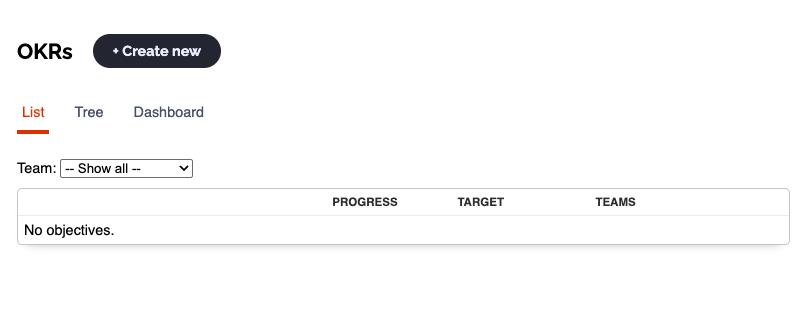
When your first join OKR Dash, your OKR list will be empty:
Sidenote: you can now Import your OKRs (and users and teams). See the Import / Migration release announcement.
Click the "+ Create New" button, and fill in the details of the OKR:
Sidenote: you can now use AI to get suggestions for your entire OKR, or just the O, or just the KRs. Read the AI suggestions release announcement.
Once you've filled it all in, press "Create OKR" at the bottom and then switch to the Tree view, and you'll see this:
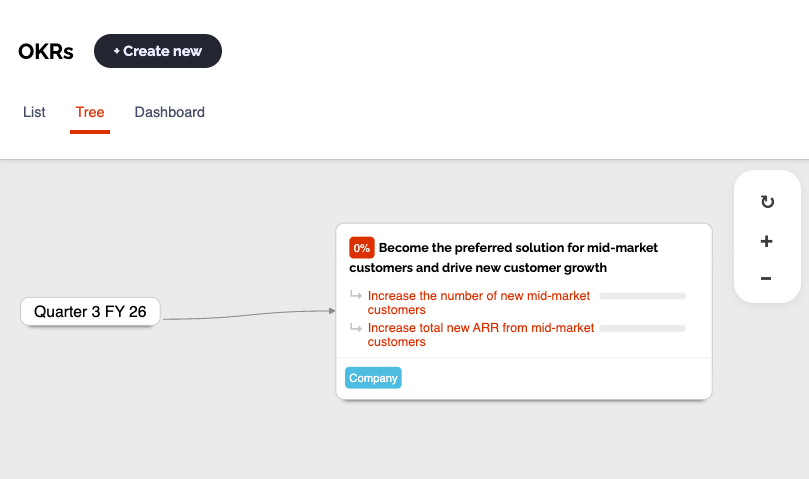
Now we have our top level goal. Across the company, departments and teams will create their objectives to realise this company outcome. Marketing, Product, Customer Success, and more.
Let’s imagine that our fictional company does both Sales-led Growth and Product-led Growth. So we’ll have a few objectives that will link directly to the goal of driving new customer revenue.
These will contribute progress to the top level, as their success means the company objective will succeed.
Sales: Build a strong, predictable mid-market pipeline for sustained deal flow
Marketing: Drive a steady stream of high-intent mid-market prospects into the funnel
Product: Turn product trials into a reliable engine for paid customer growth
We create these the same way as above, then to link these objectives in OKR Dash, we can either choose the parent when creating them, or drag and drop the relationship inside the Tree view. When children contribute progress to their parent, we add a lightweight KR into the parent with the name of the child objective, so the relationship is explicit:
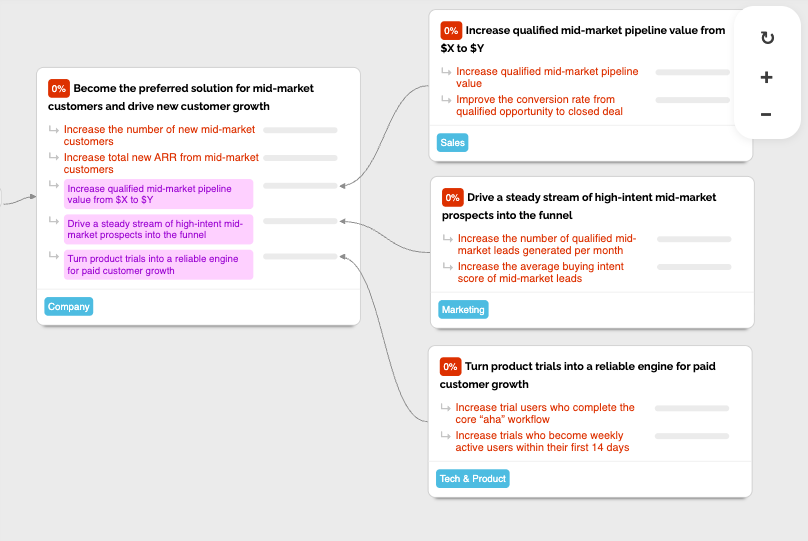
Now if any of these objectives have their progress updated, that change rolls up into the company view. If any team falls behind, leadership can see the risk to revenue immediately and intervene.
OKR Dash can also support a looser model of alignment. In our example here, the Customer Success team is going to work on keeping customers happy and retaining them for longer.
Customer success: Create a loyal mid-market customer base that stays and advocates
This will lead to a dominant mid-market position, but isn’t directly related to the stated objective of new customer growth.
So we create that link without contributing progress to the parent objective, where the arrow points to the top of the parent objective and there’s no lightweight child KR. It looks like this:
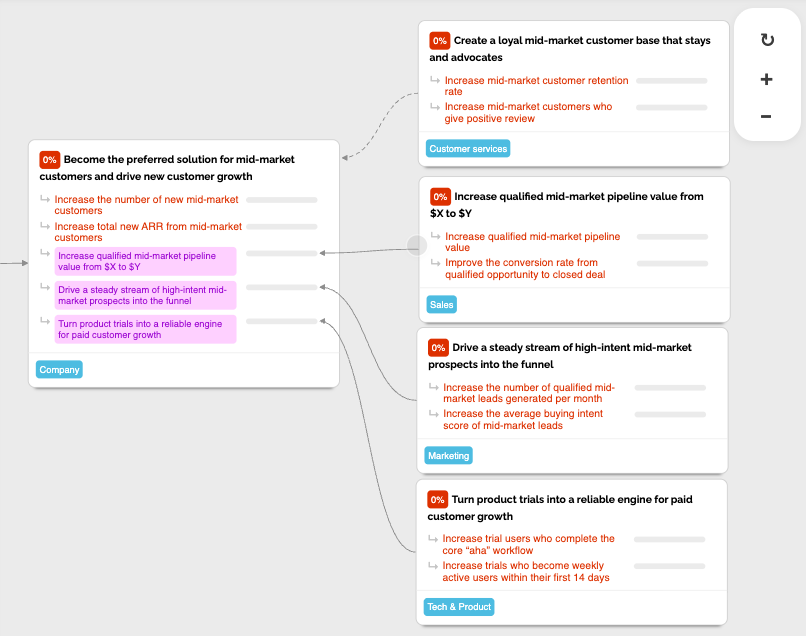
These OKRs are not just written near each other. In OKR Dash, they are linked. Now the company objective is no longer a standalone statement. It becomes a hub. You can see exactly which teams are driving it and how.
When you click on the company objective, you can see every team that is driving it and how much of their effort is tied to it. When you click on a team objective, you can see what it is supporting and what depends on it.
This is what alignment means in practice. It is a visible chain of contribution.
Why visual linking changes behaviour
- Once these relationships are visible, people start to make better decisions.
- Teams can see when they are working in a different direction to everyone else.
- Leaders can see when a key objective has too few contributors.
- Stakeholders can see where teams are duplicating effort.
- Dependencies that used to live in people’s heads are now part of the system.
For example, if sales depends on marketing to generate leads, that relationship is visible in the alignment map. When marketing changes its priorities, sales immediately sees the impact. That creates better conversations and better trade offs.
The map also makes it easier to say no. When a team proposes a new objective, it is obvious whether it supports anything important or sits off on its own.
Why documents and spreadsheets fall short
Teams are asked to write their OKRs usually in documents or spreadsheets or slides. Those OKRs are reviewed and approved. On paper, everything looks aligned.
Documents and spreadsheets list goals, but they cannot model how goals interact. You can’t reliably answer basic questions like “which company objective has the most supporting work?” or “which team OKRs are unlinked?” without manual audits.
And they proliferate. Everyone has their own copy… “Marketing_OKRs_final_v2.pdf”. Then they go stale, and new starters have to find and collate dozens of separate files in different formats to try and understand what’s going on.
The problem is that nothing connects those goals together. A team can say it supports a company objective, but there is no structure that verifies that relationship. Another team might claim the same objective. A third team might quietly work on something unrelated because no one can see the whole picture.
Docs do not show contribution. They do not show dependency. They do not update when priorities change. Most importantly, they do not give you a live view of how strategy is turning into work.
An alignment map does all of that. It is not just a place to write OKRs. It is a complete representation of how the business is trying to achieve its outcomes right now.
When you have that, OKRs stop being something you review at the end of the quarter. They become something you use every day to guide what the company works on next.
This is the missing link between company strategy and team execution.
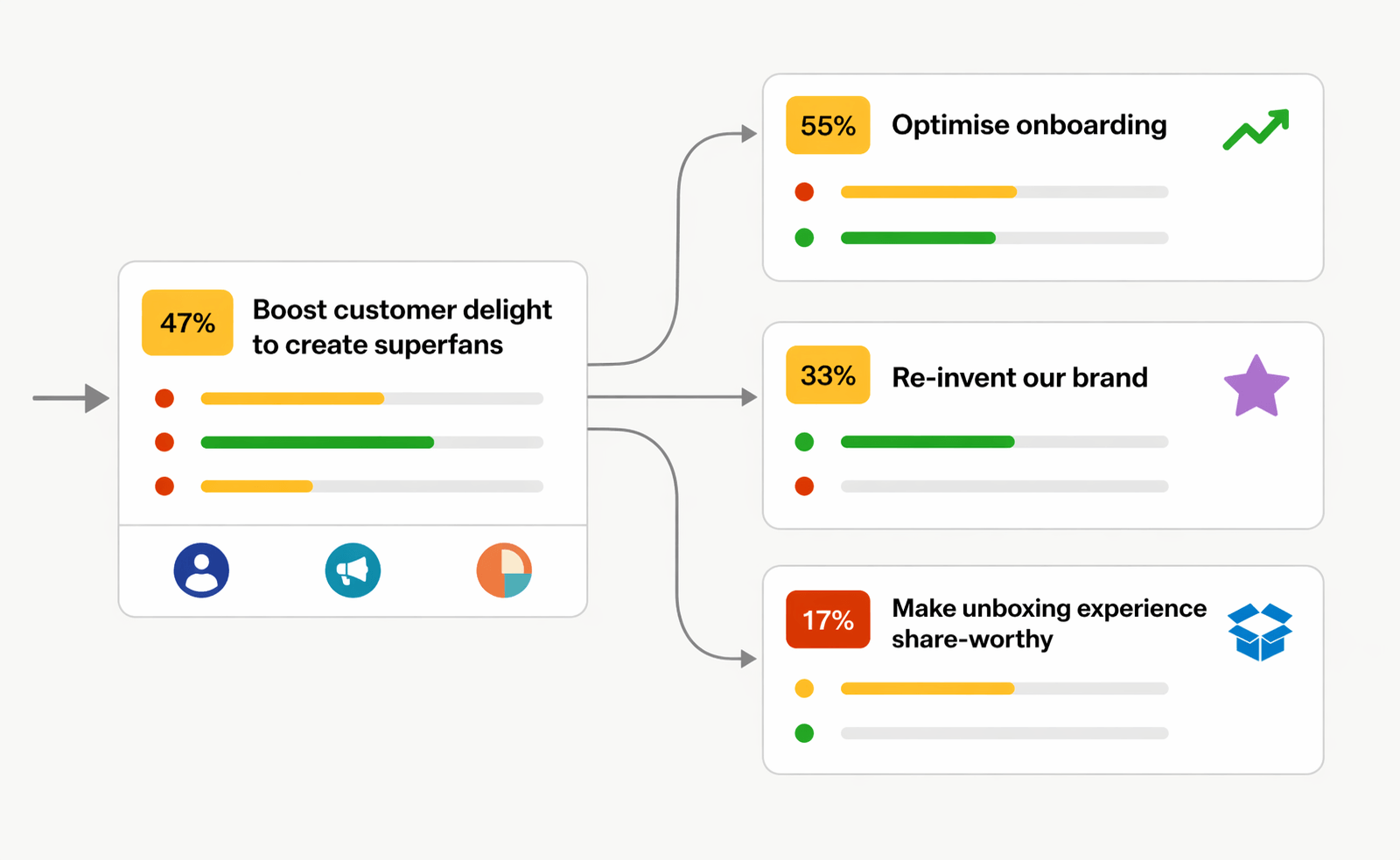
OKRs done right.
OKR Dash is a powerful tool for managing your OKRs.
No more siloed spreadsheets or manual tracking. One place to align teams and drive outcomes.