May '26
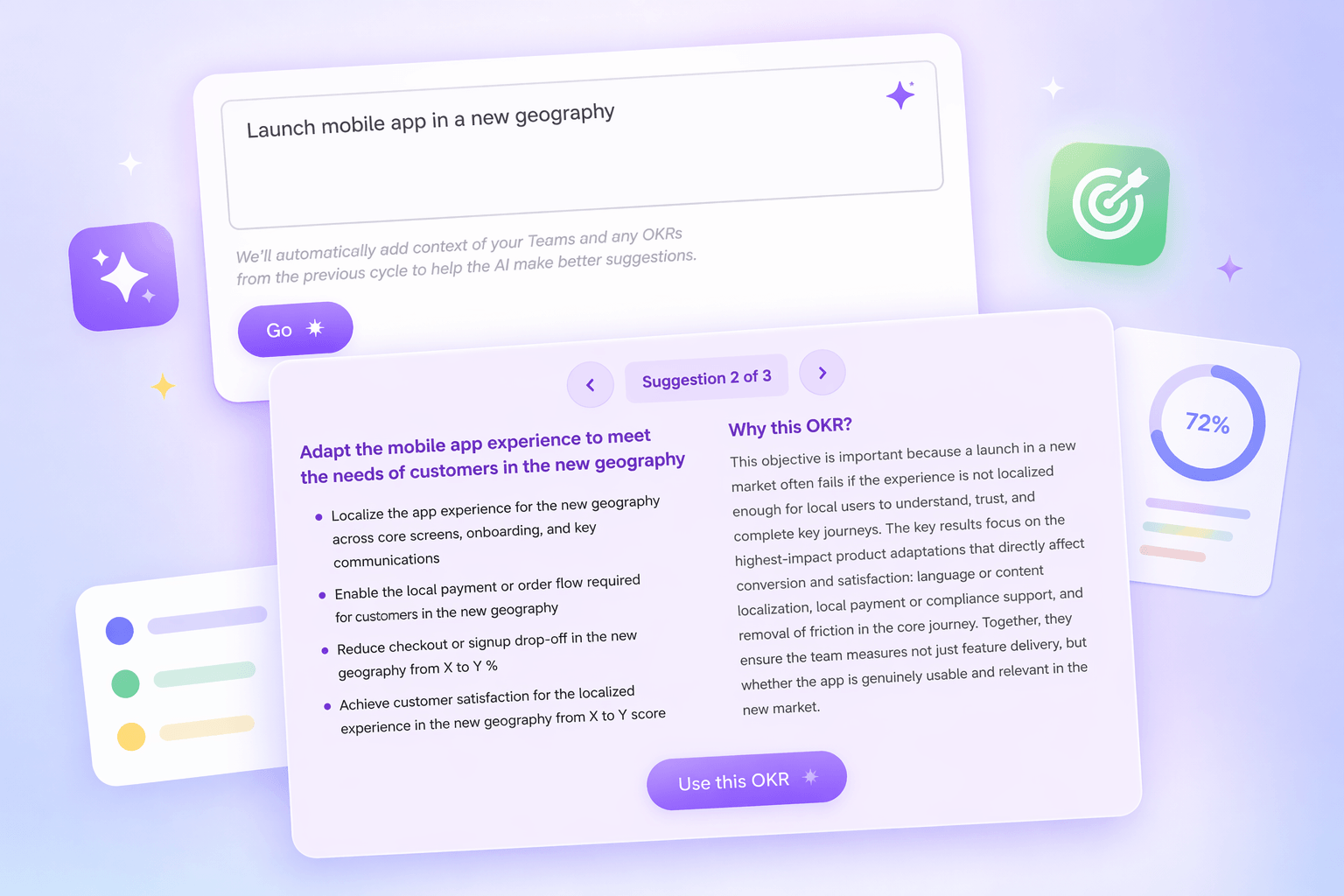
AI-Powered OKR Suggestions: Write Better Goals, Faster
You sit down to plan your OKRs and the same pattern plays out...
The room fills with ideas and the list of OKR candidates grows fast. Objectives sound vague. Key Results track activity instead of outcomes. Planning drags on because people debate wording instead of deciding direction. Teams spend hours or even days wrangling with phrasing and metrics, and nobody can agree.
The cause is simple. Writing high-quality OKRs is hard work. It requires context, clarity, and consistency across the organisation. Most tools leave that burden entirely on the user.
Today, we've fixed that.
Meet AI-Powered OKR Suggestions
You can now generate complete OKRs, Objectives, or Key Results directly inside OKR Dash using AI that understands how your organisation works.
You can:
- Enter your strategy and situation and get full OKR suggestions
- Paste a draft Objective and improve it into a clear, outcome-focused statement
- Write a rough Key Result and turn it into something measurable and decision-ready
You stay in control. You can edit every suggestion before you adopt it.
This isn’t generic AI bolted onto an OKR tool. This is an OKR system designed to help you think clearly and move faster.
Why This Works Better Than Generic AI
Anyone could open their favourite LLM and ask for OKRs. Many teams already do. The results look fine on the surface, but they miss the context that makes OKRs actually work.
1. Tuned for strategy, not just syntax
We've trained the system to prioritise outcomes over wording. It pushes Objectives toward real business impact and ensures Key Results measure success from multiple angles. You don’t just get SMART goals. You get goals that drive decisions.
Out of the box LLMs don't have this sort of focus, they'll just give you generic feedback.
2. Uses your real organisational context
Our approach draws on all the context of your workspace. It sees your existing OKRs, team structures, progress updates, and activity. It understands what other teams are working on. It know how well everyone did last quarter.
That means suggestions align with company priorities instead of drifting into isolated, local optimisation.
Your favourite chat bot doesn't have this context, and so cannot be as smart.
3. Built directly into your workflow
You don’t need to switch tools, copy text, or reformat anything. You generate, refine, and adopt OKRs in one place. That removes friction from the process and keeps momentum high during planning.
Individual chats with your LLM are invisible to everyone else, and don't contribute to shared transparency.
What This Solves
This feature directly targets the most common reasons for OKR failure:
Low-quality OKRs
You replace vague Objectives and output-based thin Key Results with clear, measurable outcomes. See our guide on how to write good OKRs for what that looks like in practice.
Weak alignment across teams
You generate OKRs that connect to existing work across the organisation, not just your local team.
Too many goals, not enough focus
You get structured suggestions that encourage prioritisation and coverage, rather than long lists.
Process becomes bureaucratic
You reduce time spent debating wording and formatting. You move straight to intent and outcomes. For a deeper look at the prompting technique behind this, see how to prompt your way to great OKRs.
Strategy disconnect
You anchor team-level OKRs in real company context, so work ladders up properly.
How to Use It
The workflow is simple and fast:
- Open any Objective or Key Result editor in OKR Dash
- For a full OKR, click "Need inspiration?" and enter your context
- For individual Objectives or Key Results, enter your draft
- Review the suggestions and edit as needed
- Save and get on with it!
Most teams go from blank page to solid OKRs in minutes.
Built for Real OKR Execution
This release strengthens OKR Dash as a complete OKR platform, not just a place to store goals.
You now have:
- A faster way to create high-quality OKRs
- A shared system that keeps everything aligned
- A workflow that removes friction instead of adding it
Combined with Snapshot Reporting, you now have a complete system from OKR creation through to weekly visibility.
Start Writing Better OKRs Today
If your team spends too long planning and still ends up with weak OKRs, this feature will change how you work.
Create clearer goals. Align teams earlier. Move faster with confidence.