How To Prompt Your Way To Great OKRs
Anyone can ask their favourite LLM to "generate my OKRs" but usually the results are not that great.
Most teams trying to use AI for OKRs have the same problems. They type a vague sentence into an AI tool, get back something that looks neat but realise it's generic and doesn't have any connection to their strategy.
The problem isn't the AI, it's the input.
This guide shows exactly how to structure prompts so you consistently get high-quality, usable OKRs instead of fluff. If you get this right, AI becomes a force multiplier rather than another admin task.
A quick real example
When I first tested AI-generated OKRs for a SaaS product, I gave it this:
We want to grow our product and improve engagement
The Objectives generated were predictably vague sounding:
| Objective | Why it's bad |
|---|---|
| Drive sustainable product growth | Unclear - what does sustainable mean? |
| Improve user engagement and habit formation | Just restates the original goal, and doesn't define engagement |
| Improve product value perception | Why? For who? What would this achieve? |
| Strengthen engagement loops and retention drivers | AI is guessing that retention is worth investing in |
On the surface these read well. They're snappy, look like proper business-speak. But, they're vague and don't describe good outcomes, and they're not specific to the situation.
It's not the AI's fault though, it doesn't have context. So I tried again:
- Company: B2B SaaS for health tech
- Current ARR: $120k
- Target: $300k in 12 months
- Most sales come from outbound, not inbound
- Weak onboarding conversion (22%)
- Strong retention after 30 days (82%)
- ICP: Management personnel in small health clinics
- Main growth channel: LinkedIn content + outbound
The output changed dramatically:
| New objective | Why it's better |
|---|---|
| Scale LinkedIn + outbound into a predictable growth engine | Specific about the growth levers we should pull |
| Turn onboarding into a reliable revenue driver | Based on the actual weaknesses in the product not just guessing |
| Improve product-market clarity and positioning for ICP | Addresses one of the core reasons for inbound leads |
| Drive ARR growth to $300k by acquiring high-quality ICP customers | A real company target. Note the Objective about retention has gone because that's not a problem |
Same AI. Completely different result. Much more relevant and accurate for the situation.
That's the whole point of this article.
Why most AI-generated OKRs are bad
There are three common failure modes:
1. Poor inputs → generic outputs
AI fills in gaps. If your prompts are oversimplified or you don't give it specifics, it defaults to safe, vague language. You've got to trigger the knowledge it has about Product and OKRs to get the best out of it.
2. No context → no relevance
Without strategy, performance data, or team scope, AI will fall back to basic best practice advice. You've got to give it everything you know (well, anything immediately relevant anyway) so it can think on your behalf.
The 4 inputs that matter most
When prompting an AI OKR generator, these four inputs drive almost all of the output quality.
1. Strategy
What are you actually trying to achieve long-term?
- Revenue targets
- Product vision
- Market positioning
- Strategic bets
Without this, you get disconnected OKRs that don't make sense for your situation, don't relate to each other and won't ladder up to your company goals.
2. Prior OKRs
What happened last cycle?
- Which KRs were missed
- Which ones were easy wins
- Where teams got stuck
This prevents repeating bad patterns, and allows the AI to think about what would naturally follow on from what came before.
3. Current performance
What does reality look like right now?
- Conversion rates
- Revenue
- Engagement
- Operational constraints
This is where opportunities comes from. The AI can see where the weaknesses are, and match those against the strategic direction and what you've already tried.
4. Team scope
What can this team actually influence?
- Ownership boundaries
- Dependencies
- Resourcing
Without this, OKRs become unrealistic or misaligned. No good having a load of front-end experiments if you have a team of back-end engineers. For more on connecting team work to company goals, see how to align company OKRs to teams.
Step 1: Write a raw context dump
Start with a messy, unstructured input.
Do not overthink formatting. Just jot down everything that comes to mind that you think about all day every day while you're prioritising initiatives.
Example:
We are a B2B SaaS tool in health-tech. Target customers are management in small to medium clinics. Growth is currently coming from LinkedIn but inconsistent. Website converts at 3%. Trial to paid is 12%. Users struggle with onboarding and don't set up their account quickly enough. Retention is strong after first week. We want to double revenue in 12 months. Last quarter we built a new onboarding flow that reduced the number of steps but it didn't have much effect. Small team, 2 engineers, 1 PM.
This is what most people skip. They jump straight to "generate OKRs". But this step is where the quality comes from. We cover this "context first" principle in more detail in how to start your OKRs from scratch.
If you want better results, organise the context slightly.
Group into the categories above: strategy, prior OKRs, metrics, team; and just write bullets.
Or if writing like this is difficult to get going (nobody likes a blank white page!), you can use this prompt to get AI to help you write it:
Ask me simple, easy questions (one at a time) so you can learn about:
- Company strategy, vision and big bets
- Prior OKRs that we've tried and the outcomes
- Current metrics and performance
- My team's scope and resourcing Once you know enough, summarise what you've learned in a structured way. I will use this summary as a prompt to generate OKRs for next quarter.
Step 2: Generate initial OKRs
The prompt needs to do 2 things: activate "OKR mode" in the LLM, and give clear instructions about what you want.
First we create a persona. We tell the AI that it is experienced, expert, thoughtful and supportive. This will trigger all the associations with the right areas of its knowledge base to produce better OKRs.
Then we give a clear instruction about what we want: 3 Os, 3-5 KRs each. Outcomes over outputs, top priorities only (don't bother listing absolutely everything, only the most impactful stuff).
Here it is:
You are an experienced Chief Product Officer (CPO). You are a thoughtful and supportive leader. You have deep expertise in Objectives and Key Results (OKRs), and you have spent time as a professional OKR coach. Using the business context below, generate 3 Objectives with 3-5 measurable Key Results, for the next quarter. KRs should be SMART, and mutually exclusive / collectively exhaustive (MECE). Focus on impact & outcomes, not delivery & outputs. Keep to top priorities only.
Context: [paste context here]
This is where a bespoke OKR platform tool can really shine. In OKR Dash, this sort of prompting is baked-in behind the scenes (actually it's much more in-depth after many refinements but the principle is the same). The AI uses not just your prompt, but also existing workspace data like prior OKRs, ownership, and structure. That extra context makes a big difference.
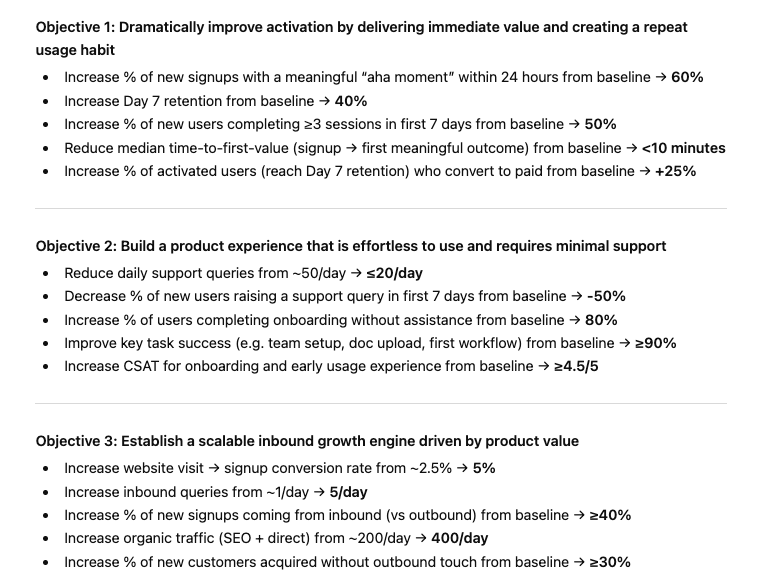
The output is already closer to usable.
Step 3: Iterate with targeted prompts
First output is rarely perfect although with good context and a solid persona prompt, you'll get 80% of the way there.
The difference between good and great OKRs comes from iteration.
Use specific follow-ups to learn more, and get the AI to reflect and iterate:
Review the OKRs and explain in one sentence each why that O was chosen, and why that KR was chosen. If any don't have a solid rationale, suggest improvements. Be honest.
Analyse the OKRs provided for weaknesses, duplicates, overlaps, outputs or unmeasurables. Suggest alternatives. Be truthful.
Imagine we complete all the OKRs, what would we achieve? How would this compare to our strategy? If it's not a strong step forward, suggest changes to the OKRs to make them more ambitious. Be objective.
(I always add "be honest" or something like that to the end to avoid any sugar-coating that some AI's are prone to doing.)
Depending on the quality of the output you've got in the first run, you could also try more simple prompts like:
- “Make the key results more measurable”
- “Make this more ambitious but realistic”
- “Align these more clearly to revenue growth”
- "Convert output KRs to outcomes”
If you're not sure what strong Key Results look like, these OKR examples are a useful reference. Iterating is where most teams give up too early. They just accept the first draft, which means you're missing opportunities to make the OKRs really excel.
Instead, treat it like a working session with a CPO as your partner and keep going until you're happy.
Why ChatGPT, Grok, Claude etc are not the right tools for this
As I said above, any LLM chat bot can generate OKRs, and with good prompting you can get reasonable results.
But, they have drawbacks and friction:
- They treat OKR generation as a one-off action in isolation from the rest of the company
- They forget context between sessions, so you have to re-create it (or at least keep copy/pasting)
- They don't have visibility of what's happening in your company, so you have to update the context frequently
- The OKRs aren't in your normal workflow, so you have to move them into the right place
- The conversational UX is clunky for iterating over the OKRs after generation
- They are generalist tools, not specifically tuned for thinking about business, Product and OKRs
This is where a proper OKR system matters - OKR Dash is a bespoke platform that can boost your output.
How OKR Dash improves the process
1. Seamless iteration inside your workflow
OKR Dash is the central place for all of your OKRs. Everyone creates and manages their OKRs there, and all stakeholders are in there too, reviewing and discussing progress.
You generate, iterate, publish and review your OKRs in the same place. No copy/pasting. No switching tools.
The process is lightweight and easy instead of messy and chaotic.
2. Context-aware generation using workspace data
Our AI doesn't operate in isolation. It knows about:
- Your OKRs from previous quarters
- Ownership of Os and KRs
- Progress updates (which includes metric values)
- Discussions about the KRs with stakeholders
- Team structures and missions, and resourcing
All this is used as context for the model which leads to more relevant outputs with no extra effort.
3. Custom tuned model to focus on strategy, not syntax
We have tuned our models and prompts to maximise the efficiency and power-output specifically for business, Product and OKR generation.
And we're always improving that intelligence, iterating on the setup to ensure it's the best response you could get out of any LLM. So you don't have to.
4. Multiple generation modes
You can enter free-text information about your situation and get an entire OKR generated, or you can enter a draft O or KR and get suggestions for improvement.
This way you can avoid staring at a blank page and get going, or if you've already got some ideas you can deploy the AI to improve them.
Learn more about AI-powered OKRs in OKR Dash here
Final takeaway
If your AI-generated OKRs are poor, it's almost always an input problem. Fix the inputs, and the outputs follow.
The process is simple:
- Document real context
- Generate OKRs
- Iterate with precision
Do this consistently, and you move from vague goals to decision-ready OKRs that actually drive work.
And it's worth trying a tool built specifically for this workflow!
👉 Create your free workspace and start generating better OKRs today
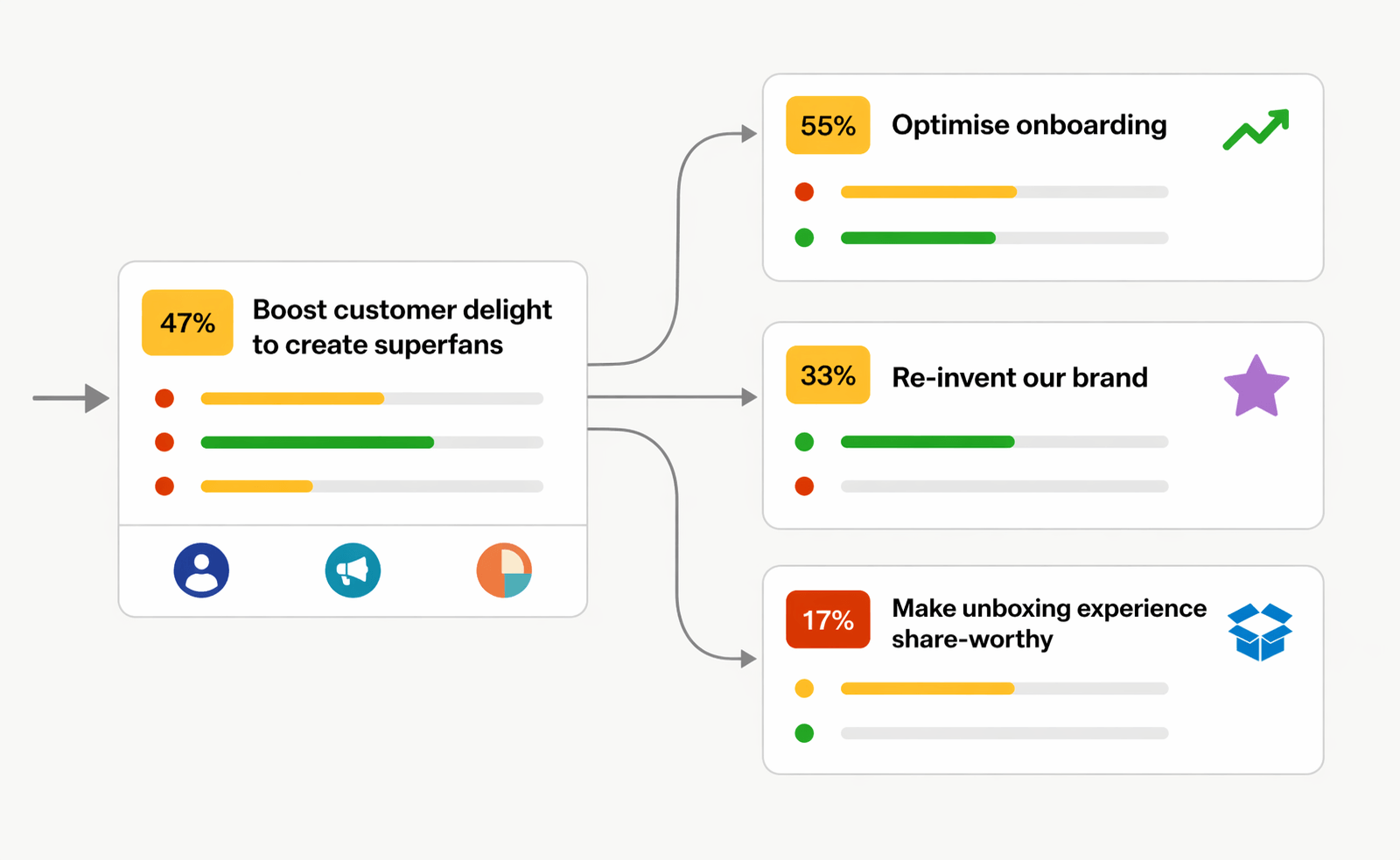
OKRs done right.
OKR Dash is a powerful tool for managing your OKRs.
No more siloed spreadsheets or manual tracking. One place to align teams and drive outcomes.