How To Start Your OKRs From Scratch
Starting OKRs from a blank page is hard.
You sit down in a planning session and people start throwing out ideas. Someone suggests improving growth, someone else mentions retention, a third person wants to fix tech debt. Before long you've got 15 Objectives, none of them clearly connected, and a list of Key Results that are either vague or impossible to measure.
Three weeks later, nobody is looking at them.
Most of the time, OKRs don't fail because the framework is flawed. They fail because the starting point was no good.
This guide walks through a structured way to go from zero to an aligned set of OKRs, using context rather than brainstorming.
A quick real example
I recently worked with a small product team that had no formal OKR system. Their previous quarter looked like this:
- 12 Objectives across 3 teams (4 each!)
- No clear company-level priorities
- Key Results like "Improve onboarding experience" and "Increase engagement"
We scrapped everything and started again using the method below. After a couple of sessions, they had:
- 3 company-wide Objectives
- 8 total Key Results across the company
- Clear ownership on every item
The teams felt more engaged, everyone was clearer on the direction, and things actually got done. The difference wasn't effort — it was structure.
Why “blank page brainstorming” fails
Most teams treat OKR planning like a creative exercise. You open a doc, start brainstorming, and try to come up with good goals. That tends to produce a few predictable problems:
- Opinion-driven OKRs: The loudest voice wins
- Inconsistent quality: Some OKRs are measurable, others are vague
- Too many goals: Everything feels important
- Weak alignment: Teams optimise locally, not globally
This is why OKR planning often ends up feeling slow and bureaucratic — you spend weeks debating wording instead of making decisions. If you want to shortcut this with AI, read our guide on how to prompt your way to great OKRs.
The “Context First” principle
OKRs should be derived, not invented.
Instead of starting with ideas, you start with context. That context tells you what matters, and the OKRs follow naturally from it. It's a small shift in thinking, but it turns OKR planning from guesswork into something repeatable.
Step 1: Capture strategic inputs
Before writing a single Objective, gather the inputs that reflect where things actually stand.
This usually includes:
- Company priorities (growth, profitability, expansion, etc)
- Constraints (budget, team size, technical limitations)
- Recent learnings (what worked, what didn't last quarter)
- External factors (market shifts, competition, seasonality)
Write it as plain text — no formatting needed. Just get it down.
This is where having the right tools makes a difference. In most setups, this context ends up scattered across docs, slides, and Slack threads, and when it's time to write OKRs, people rely on memory.
A good OKR platform lets you centralise this context and use it directly. In OKR Dash, you can paste your raw context and generate structured OKRs from it using AI. The system knows your workspace, your teams, and your past OKRs, so it doesn't start from zero every time. That cuts out a lot of manual work and inconsistency.
Step 2: Define 2–3 company-level outcomes
This is a good time to force focus. Using the context you've gathered, ask:
What are the 2–3 outcomes that actually matter this quarter?
These should be outcomes, not activities.
Bad:
- Launch new onboarding flow
- More revenue than last quarter
- Hire 3 new sales people
Good:
- Increase activation rate for new users so we can spend less on Marketing
- Improve retention in first 30 days to avoid losing customers to a new competitor
- Reduce spend on third party technology now that it's cheaper to host it ourselves
This is where most teams get stuck — they try to keep everything. But if something doesn't make the top 2–3, it's not a priority this quarter. It might still be important work, but it's not an OKR.
With OKR Dash, you can generate multiple Objective drafts from your context and iterate quickly, without rewriting everything manually each time.
Step 3: Add Key Results
Now define how you will measure progress.
Each Objective should have 2–4 Key Results.
These are specific, measurable signals.
Examples:
- Increase onboarding completion rate from 42% → 60%
- Reduce time-to-first-value from 3 days → 1 day
- Increase week 1 retention from 25% → 40%
Avoid:
- “Improve user satisfaction”
- “Enhance performance”
If you can't measure it, it's not a Key Result. Not sure what good looks like? Check out these examples of good and bad OKRs.
This is where quality varies massively across teams. Many OKRs fail because the Key Results are weak.
A good OKR tracking software or OKR management tool helps here by enforcing structure and making progress visible over time. OKR Dash uses AI to automatically improve your Key Results, just enter your draft and click.
Step 4: Cut
You'll almost certainly end up with too many things. This is the step most teams skip, but it's worth spending time on: go through everything and remove anything that isn't essential. You can always add things back mid-quarter.
For each item, ask:
- Does this directly contribute to a top-level Objective?
- Is this really measurable? Can we measure it today, and can we set a realistic target?
- Is this the best use of effort this quarter? Is the outcome worth it?
If the answer is no, cut it. You should end up with a small, focused set of OKRs — that's what makes execution possible.
Example: zero → structured OKRs
Here’s a simplified example of OKR setup process from scratch.
Context:
- New product underperforming
- Low activation and retention
- Limited engineering capacity
- New competitor just launched
OKRs:
-
Improve positioning of the product's benefits so new user's can clearly see
- Increase activation rate from 42% → 60%
-
Ensure new users get their "Aha!" moment and experience the value we can offer
- Reduce time-to-first-value from 3 days → 1 day
- Increase week 1 retention from 25% → 40%
Total: 2 Objectives, 3 Key Results.
That’s it.
Compare that to the typical 10–15 Objective sprawl.
Final thoughts
The real goal is not just to do this once. It’s to make it repeatable.
Each quarter, you should:
- Capture fresh context
- Re-evaluate company priorities
- Generate draft OKRs
- Refine and cut
This is where most setups break down. The process becomes slow and manual, so teams either rush it or skip it.
If you take one thing from this guide, it should be this:
Don’t start with a blank page. Start with context.
That single shift removes most of the common OKR problems:
- Too many goals
- Weak alignment
- Vague Key Results
- Bureaucratic planning
You end up with a small, focused set of OKRs that actually drive progress.
Try this in OKR Dash
If you want to put this into practice, it helps to have a system that supports this workflow. OKR Dash is built for exactly that:
- Turn raw context into structured OKRs using AI
- Keep teams aligned with a clear, visual hierarchy
- Track progress with real, measurable updates
- Make OKRs something people actually use week to week
- Get AI-powered suggestions for your Objectives and Key Results
If you're currently managing OKRs in docs or spreadsheets, you're doing a lot of this by hand — and it probably shows.
Create your workspace and generate your first set of OKRs in minutes.
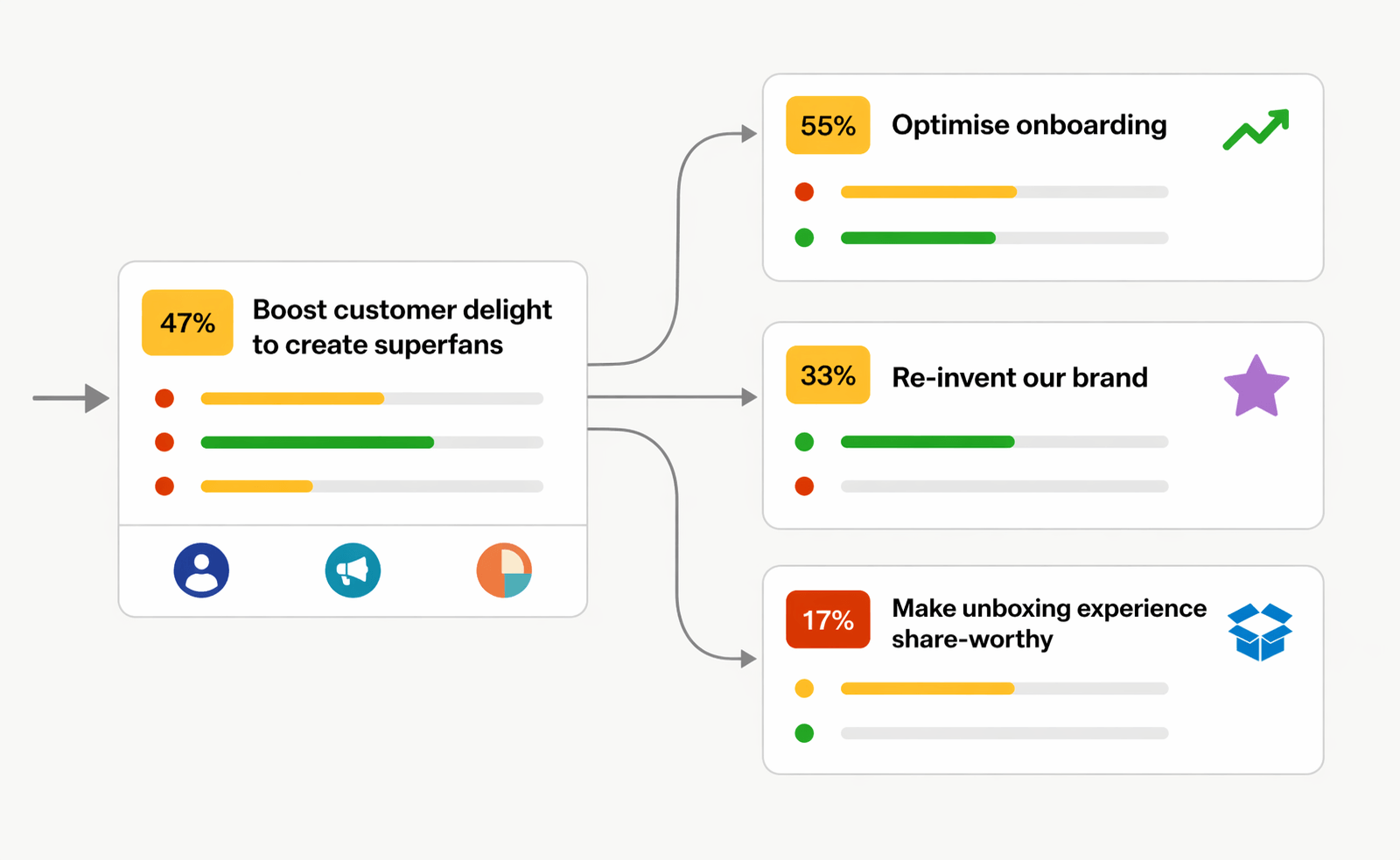
OKRs done right.
OKR Dash is a powerful tool for managing your OKRs.
No more siloed spreadsheets or manual tracking. One place to align teams and drive outcomes.