OKR Quality Scoring Is a Vanity Metric
OKR quality scoring feels reassuring. You write an Objective, define some Key Results, run it through a rubric or an AI tool, and get a score back. A 7 out of 10, maybe an 8. There's a natural urge to bump that number up.
But think about how much time goes into improving the score versus improving the actual work. More often than not, teams end up polishing language while the real priorities stay exactly the same.
OKR quality scoring adds process overhead, encourages performative behaviour, and quietly disengages the people who just want to get on with things. If rewriting an OKR doesn't change what anyone does next week, it's noise.
This article looks at why OKR scoring rubrics fail in practice, why AI scoring doesn't solve the problem, and what you can do instead.
The appeal of scoring
On the surface, OKR scoring looks like best practice. It gives teams structure - a way to judge whether an OKR is "good enough" to sign off, and a way to standardise quality across the company.
A typical rubric might evaluate things like:
- Clarity of the Objective
- Measurability of Key Results
- Alignment to company strategy
- Outcome vs output focus
Wrap that in a framework or an OKR tool and you've got numbers to track. It feels objective, almost scientific.
For leaders, that's comforting - it signals rigour and suggests the organisation is "doing OKRs properly". For teams, it creates a clear target: write OKRs that score highly. "What gets measured gets managed", right?
That's exactly where the problem starts.
Why it breaks in practice
Scores reward phrasing, not substance
Most scoring systems evaluate how an OKR is written rather than what it actually drives. So teams learn to optimise for wording. They rewrite Objectives to sound more outcome-focused, tweak Key Results to look more measurable, and align phrasing to match the rubric.
The score goes up, but the underlying work stays the same. Same priorities, same execution challenges, same blockers - just described in slightly better language.
That's the first trap. Quality scoring creates the illusion of improvement without changing anything real.
It creates false confidence
Once an OKR gets a high score, it starts to feel validated. "This is an 8 out of 10 OKR." "These are strong Key Results."
That confidence is usually misplaced, because the score is based on surface-level attributes - not whether the OKR will actually drive impact. Teams stop questioning whether they've picked the right outcome and assume the OKR is "done".
That's how OKRs become set-and-forget. If you want to understand what actually keeps OKRs alive, read about how to create a living OKR system.
AI scoring doesn't fix it
More tools have started using AI to score OKRs, and on paper it sounds like a step forward: more context, better analysis, smarter feedback.
In practice, it just speeds up the same problem. AI scoring still evaluates the artifact, not the behaviour it drives. It can tell you a Key Result is measurable, clear, buzzwordy etc. What it can't tell you is whether your team will act any differently because of it.
So teams end up in a loop - score, tweak, re-score. Faster and smoother, sure, but still largely performative.
The hidden cost
The real issue with OKR scoring isn't that it's wrong - it's that it's a distraction. It shifts time and attention away from the questions that actually matter:
- Are we working on the right problem?
- Are these the right signals to track progress?
- What decisions will we make based on this?
Instead, teams end up asking:
- How do we get this from a 6 to an 8?
- Does this wording match the rubric?
- Can we make this sound more outcome-driven?
That's how OKRs become bureaucratic. Long workshops, round after round of edits, slightly better phrasing - and no real change in what anyone actually does. Over time, people disengage. They see the process but can't see the point.
The "Action Test"
A simple way to cut through all of this is what I call the Action Test: if you rewrote this OKR, would it change what the team does next week?
If the answer is no, the change isn't meaningful.
Most scoring-driven improvements don't pass this test. They make the OKR read better, maybe make it easier to present, but they don't change anyone's behaviour. And ultimately, behaviour is what counts.
What actually matters
So if scoring isn't the answer, what is? The real leverage is upstream - before anyone writes a single word.
1. Choosing the right outcome
A strong Objective isn't about phrasing, it's about focus. Does this outcome matter to the business? Will achieving it create real impact? If those questions don't have clear answers, no amount of scoring is going to help.
2. Choosing meaningful signals
Key Results should reflect genuine progress - not activity, not outputs, not vanity metrics. You want signals that tell you whether the outcome is actually happening.
This is where most OKRs fall down, and where scoring systems are weakest. They can check if something is measurable, but not if it's meaningful. For practical guidance on choosing the right Key Results, see examples of good and bad OKRs.
3. Keeping OKRs decision-ready
OKRs should help teams make decisions. When a Key Result moves, what happens next? Do you double down, change approach, or ask for help?
If an OKR can't trigger action, it's just a reporting artifact. That's why OKR progress tracking and visibility matter far more than scoring. Teams need to see what's happening and respond as things unfold. Our real-time reporting is designed for exactly this.
Our stance at OKR Dash
This is why we made a deliberate choice: we don't include OKR quality scoring in OKR Dash. Neither a rubric nor AI score in sight. It simply doesn't improve outcomes in the way people expect it to.
Instead, we focus on helping teams get it right from the start.
AI that generates, not judges
OKR Dash uses AI to help you:
- Generate entire OKRs with AI from real context
- Get AI suggestions for individual Objectives and Key Results
- Refine ideas quickly without drawn-out workshops
The goal is to do the heavy lifting upfront, so you start with strong, outcome-focused OKRs and don't need to score them later.
Less process, more execution
Without scoring, there's one less layer of friction. No extra step or box to tick for sign-off, no additional metric to chase, no second-guessing.
Just generate, sense-check, and start executing. That keeps cognitive overhead low and teams focused on the work itself.
Built for real OKR management
OKR Dash is designed as practical OKR management software, not a theoretical framework. It helps teams:
- Track progress in real time
- Maintain visibility across teams
- Keep OKRs active and relevant throughout the quarter
The value comes from execution, not from scoring.
Stop optimising for scores
OKR quality scoring feels useful. It looks structured and it gives you a number to point at. But it rarely changes what anyone does - and without a change in behaviour, there's no impact.
If your team is spending more time improving scores than improving work, the focus is in the wrong place.
Instead of scoring, use AI to help you create better OKRs upfront, rather than judging them after the fact. That's how you avoid bureaucracy, keep teams engaged, and make OKRs actually drive progress.
Try OKR Dash
If you want to move past performative OKRs and towards real execution, OKR Dash is built for that.
- Generate AI generated OKRs from your context
- Get fast, practical suggestions without lengthy workshops
- Track progress with a clear OKR dashboard
- Keep teams aligned and engaged throughout the quarter
No scoring, no busywork, no false precision - just a simple, effective OKR platform that helps teams focus on outcomes and take action.
Register for OKR Dash and start building OKRs that actually change what your team does next week.
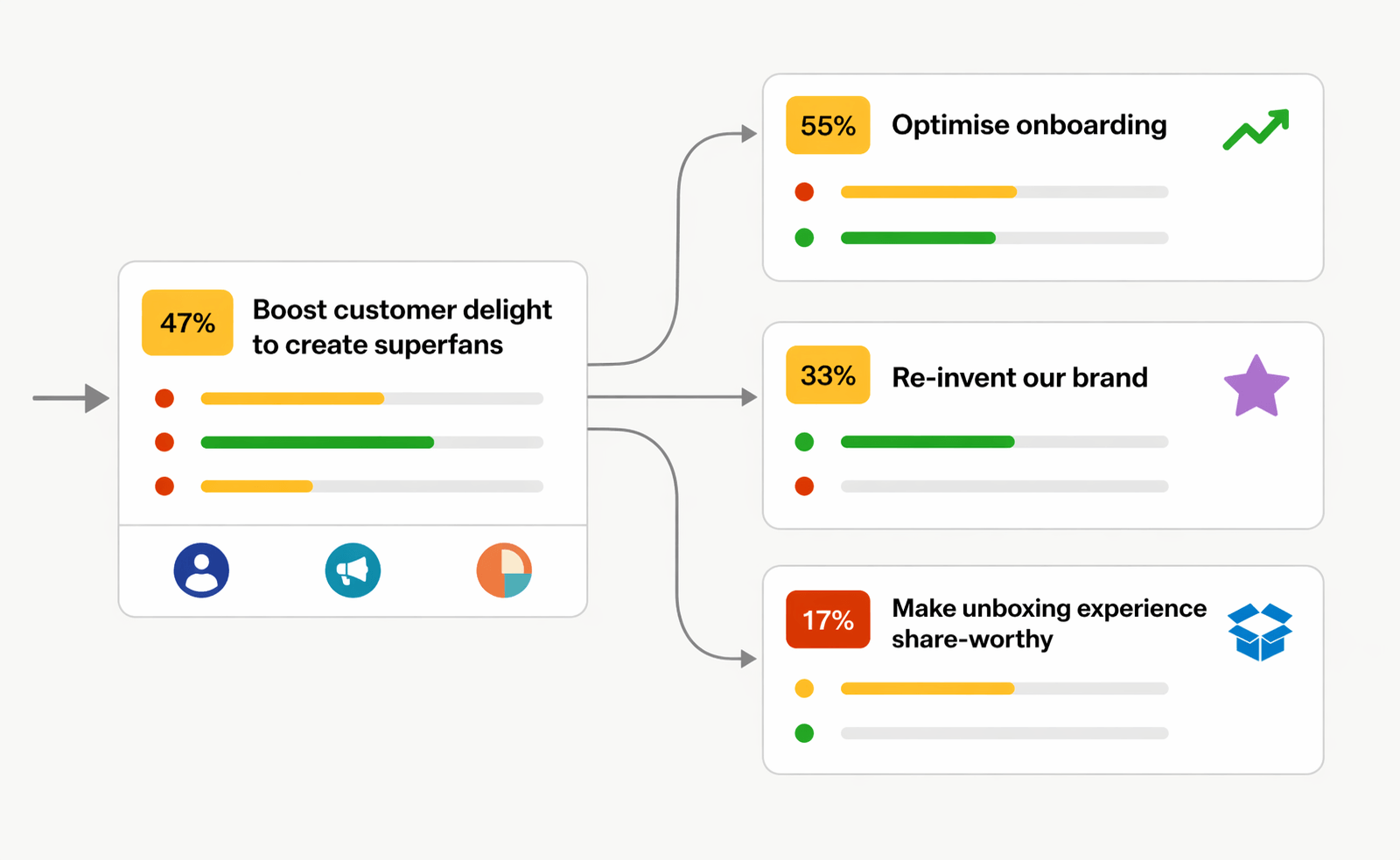
OKRs done right.
OKR Dash is a powerful tool for managing your OKRs.
No more siloed spreadsheets or manual tracking. One place to align teams and drive outcomes.