December '25
Introducing Visual OKR Alignment in OKR Dash
Alignment is one of the most discussed and most misunderstood parts of OKRs.
In theory, OKRs are meant to create focus and alignment across an organisation. In practice, teams often struggle to understand how their work relates to others, how progress should roll up, and when alignment becomes unhelpful bureaucracy.
Today, we are introducing a new OKR alignment model in OKR Dash, designed to reflect how work actually happens across teams, while avoiding the common pitfalls of traditional cascading OKRs.
The problem with visibility, not intent
Most work inside a company is connected. Teams influence each other, depend on shared outcomes, and contribute to broader goals.
The challenge is not intent. It is visibility.
When teams cannot clearly see:
- how their work relates to company objectives
- where dependencies exist
- whether progress should roll up or remain independent
Alignment either becomes rigid and misleading, or so loose that it provides little value.
This problem becomes more pronounced as organisations move faster. With AI accelerating delivery, teams can execute quickly, but without a clear view of how effort connects, speed amplifies fragmentation rather than focus.
Why traditional cascading OKRs often fail
Cascading OKRs are often criticised, and usually for valid reasons.
In many implementations, cascading turns into a top-down decomposition of work:
- Objectives are pushed downward
- Teams inherit goals that do not reflect their real scope
- Wording for KRs and Os gets mixed up
- OKRs slowly resemble a task hierarchy
This approach undermines autonomy and distorts signal. Teams spend time maintaining structure rather than understanding outcomes. Need better OKRs to align in the first place? Learn how AI prompts can help.
We wanted to preserve what cascading tries to achieve, alignment and clarity, without inheriting its downsides.
Our philosophy: alignment should be explicit, optional, and honest
The alignment model in OKR Dash is built around a few core principles:
- Teams own their OKRs
- Relationships between OKRs should be visible
- Progress should only roll up when it genuinely represents dependency
- Alignment should never force artificial structure
Alignment flows upwards and is many-to-one. A parent Objective can have many children, but each child aligns to a single parent. This keeps relationships clear and intentional.
Most importantly, alignment comes in two distinct forms.
Two types of alignment
Simple OKR alignment
Simple alignment is used when work is related, but not a hard dependency.
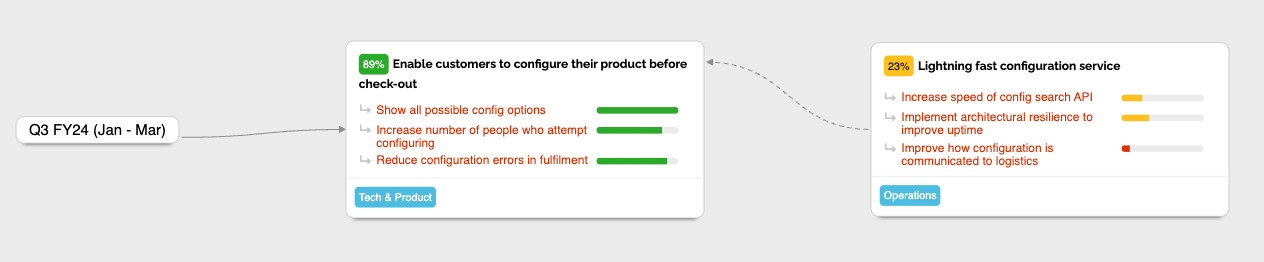
It allows teams to show that their work supports a broader objective, without affecting the parent’s progress. No matter how complete the child OKR becomes, the parent’s progress does not change.
This is useful when:
- teams are working in parallel toward the same goal
- work operates in the same problem space but is not dependent
- visibility matters more than aggregation
Contributing OKR alignment
Contributing alignment is used when progress should roll up.
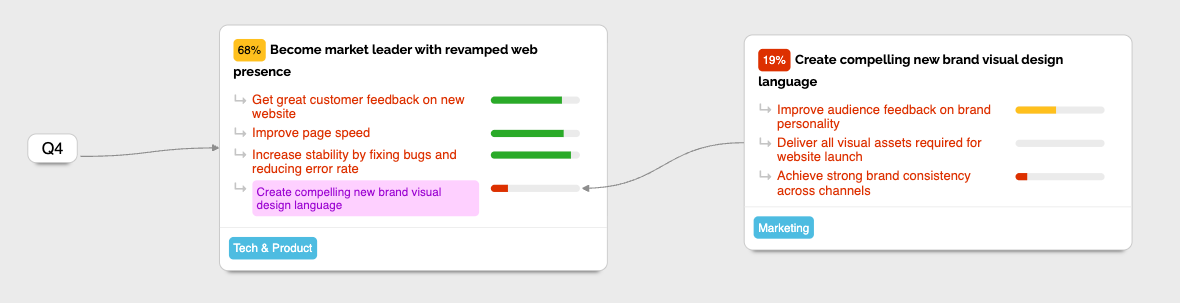
In this case, the child OKR contributes directly to the parent’s progress. As children advance, the parent updates accordingly.
This works well for:
- cross-team dependencies
- grouping outcomes into larger initiatives
- tracking progress on multi-team deliverables where completion matters collectively
The key distinction is intent. Progress only rolls up when it should.
Avoiding naming confusion in real-world OKRs
One practical challenge with alignment is naming.
When Objectives and Key Results are linked across levels, users are often forced to invent additional Key Results, duplicate wording, or choose between awkward constructs like “KR as Objective” or “Objective as KR”.
We chose a pragmatic approach.
When a child Objective contributes to a parent, OKR Dash automatically adds a lightweight custom Key Result to the parent, using the name of the child Objective. This Key Result represents the relationship, not a new piece of work.
It is not a perfect abstraction, but it removes unnecessary cognitive load:
- no need to invent new KR names
- no duplication of child Key Results
- ownership and clarity remain intact
The structure stays simple, and the intent remains clear. And in future when we're improving the Objective detail view, we can use this relationship to pull in all the relevant information about progress in the children.
Seeing alignment in the Tree view
Alignment is easiest to understand visually.
In the Tree view:
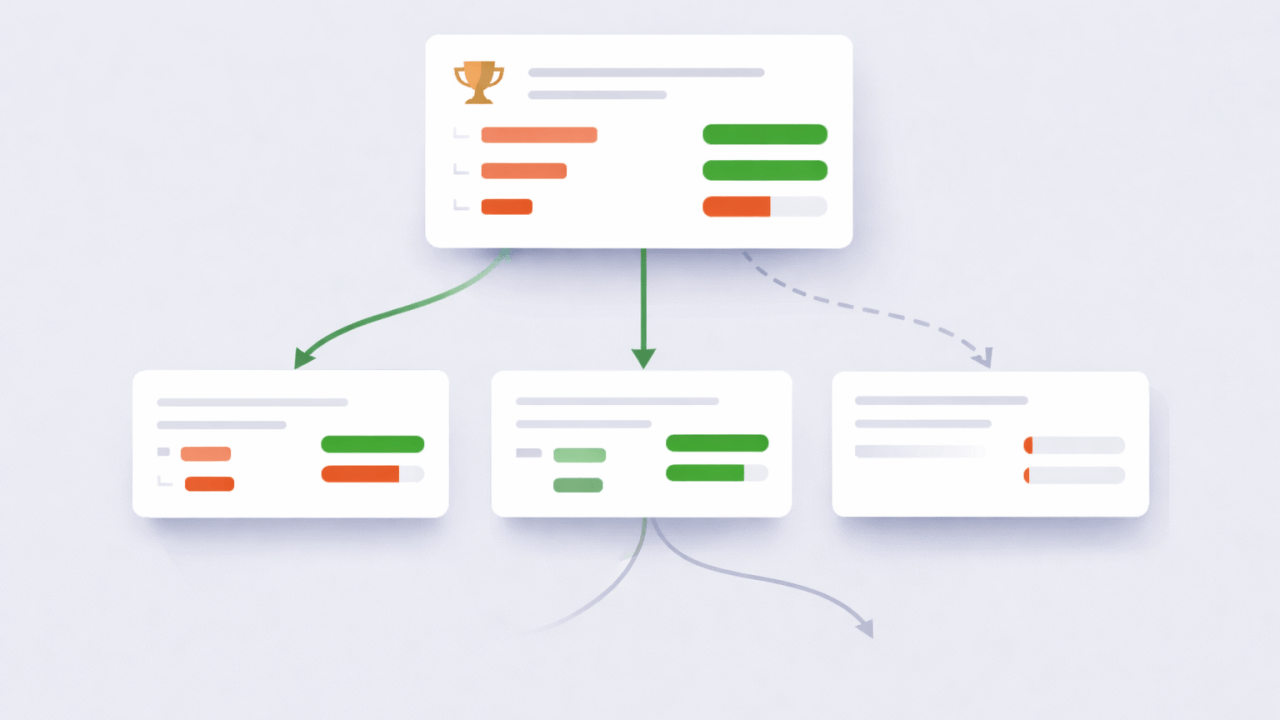
- solid arrows represent contributing alignment
- dotted arrows represent simple alignment
At a glance, teams can see how work connects, where dependencies exist, and how progress flows across the organisation. This makes alignment something teams can reason about, not just configure.
Alignment without rigidity
This release is not about enforcing a new way to write OKRs. It is about giving teams the tools to model reality more accurately.
By separating relationship from progress, OKR Dash supports:
- autonomy without isolation
- visibility without forced roll-ups
- alignment without turning OKRs into a task system
We believe this strikes a better balance between structure and flexibility, especially for modern, fast-moving teams.
Get started
Visual OKR alignment is now available in OKR Dash.
If you want clearer visibility into how work connects across teams, without the downsides of traditional cascading, we would love for you to try it.